Powder Coating
Our spray booth and oven take components up to 6 metres long, and we offer a full range of RAL and BS colours in epoxy, polyester and nylon powders.
What is powder coating?
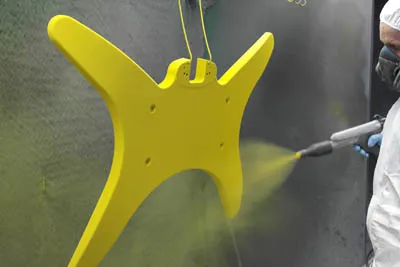 Powder coating is a widely used way of giving products a decorative and protective finish, from white goods and leisure equipment to architectural cladding, vehicle trim, electronic enclosures, railway interiors and office furniture.
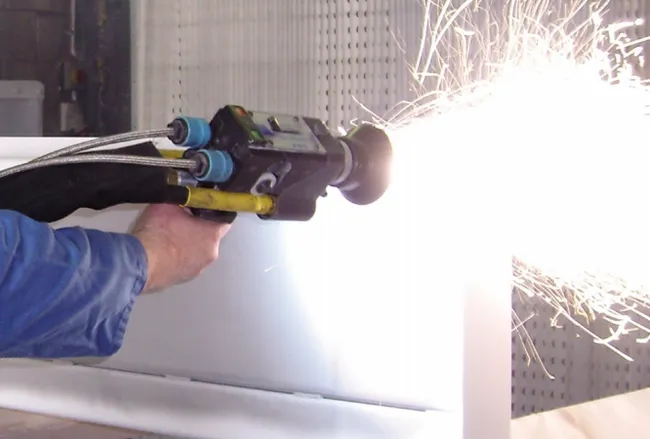
The powder is a mix of finely ground resins and pigments, usually applied with an electrostatic spray gun. The gun charges the powder as it's sprayed, so it clings to the earthed component. The part then goes into an oven, typically at 180°C to 220°C, where the powder melts into a continuous film.
What can be powder coated?
Most metal items can be powder coated, as long as they conduct electricity and can take the heat of the oven. That covers everything from small brackets and components up to fabrications 6 metres long. Every job starts with the right preparation, which for steel usually means shot blasting first.
Why choose powder coating?
- It's tougher and more flexible than wet paint, so it's less likely to chip or peel
- Unlike many wet paints, it contains no solvents or VOCs
- It gives an even finish over large areas, with no visible spray direction
- Two-colour finishes are possible with masking
Nylon coating
As well as epoxy and polyester powders, we apply nylon coatings. Pure nylon coatings, based on polyamide resin, have excellent resistance to chemicals (especially oils and solvents), stand up well to impact and abrasion, and give a low-friction surface.
Nylon is applied by electrostatic spray, so colour changes are quick and we can offer a full range of RAL and BS shades. It costs more than polyester at first, but its resistance to wear, abrasion and impact usually pays for itself many times over in lower maintenance and replacement costs.
Nylon coating is a major part of our day-to-day work. We're an approved Rilsan applicator and have built up considerable expertise with it. Other benefits of nylon include:
- it's made from renewable resources
- it's non-toxic
- good corrosion resistance
- good thermal insulation, ideal for surfaces that need to feel warm to the touch
- it stays flexible at low temperatures
We hold certified colour formulations for all standard colours on our spectrophotometer, and can match accurately to any colour sample. RAL, BS, Pantone, NCS and Munsell charts are available. Have a look at our colour chart for more on choosing a colour.
Getting a quote
To price a job accurately, it helps to know the sizes and quantities, the material, the colour (a RAL or BS number is ideal) and the finish you're after, and when you need the parts back. Photos or drawings help too, so mention them when you send us a message.